
Estate Planning Made Simple. Protection Made Certain.
ESTATE PLANNING ESSENTIALS | ARTICLE 1 OF 6

Before You Die, You Need a…
Go ahead. Finish that sentence...
I’ve asked that question to hundreds of people in seminar rooms, living rooms, and community centers across Oregon. Almost every single time, people say the same thing:
| “A will. Before I die, I need to have a will.”
And when I ask why (why a will specifically), the answers are almost always the same too:
“That’s what I’ve always been told.”
“That’s what my parents had.”
“It just seems like the right thing to do.”
I don’t say this to make anyone feel bad. I say it because I was right there with them. I grew up believing the same thing. And it wasn't until estate planning became personal, very personal, that I understood how much most of us don’t know about what actually happens when we die.
Here’s the follow-up question I always ask next, and it’s the one that changes the whole conversation:
The Question Nobody Asks
Here’s the follow-up question I always ask next, and it’s the one that changes the whole conversation:
| “Do you know what actually happens if you die with a will?”
Most people pause. A few say “probate.” Almost nobody can tell me what that word actually means.
That's not a criticism. It's just a reality. We’re taught that we need a will, but nobody teaches us what a will actually does. And more importantly, what it does not do.
So that’s what this series is about. Over the next five articles, I’m going to walk you through what I walk families through in person. The real difference between a will and a trust, what probate actually costs you, and how to make sure your plan protects your people, not just your paperwork.
Why I Do This Work
I’m a Marine. We had a saying: the 7 P’s. Prior Proper Planning Prevents Piss Poor Performance. (Pardon the language. That's the Marine version.)
Planning isn’t just a professional value for me. It’s personal.
My parents divorced when I was in third grade. My mom and stepdad were union employees. Deliberate, prepared people. They’ve had a trust in place for decades. My dad was an entrepreneur his whole life. Always moving, always building, never quite getting around to the planning part.
This year, I had to step in and take over my father’s medical decision-making. And then I watched him pass away.
The contrast between my two parents’ situations is the reason I do what I do. One side of my family had a plan. The other side didn’t. I’ve seen both outcomes up close. The difference is not just financial. It's the difference in stress, in clarity, in peace of mind for the people left behind.
It is all about planning.
Two Plans. You’re Already on One of Them.
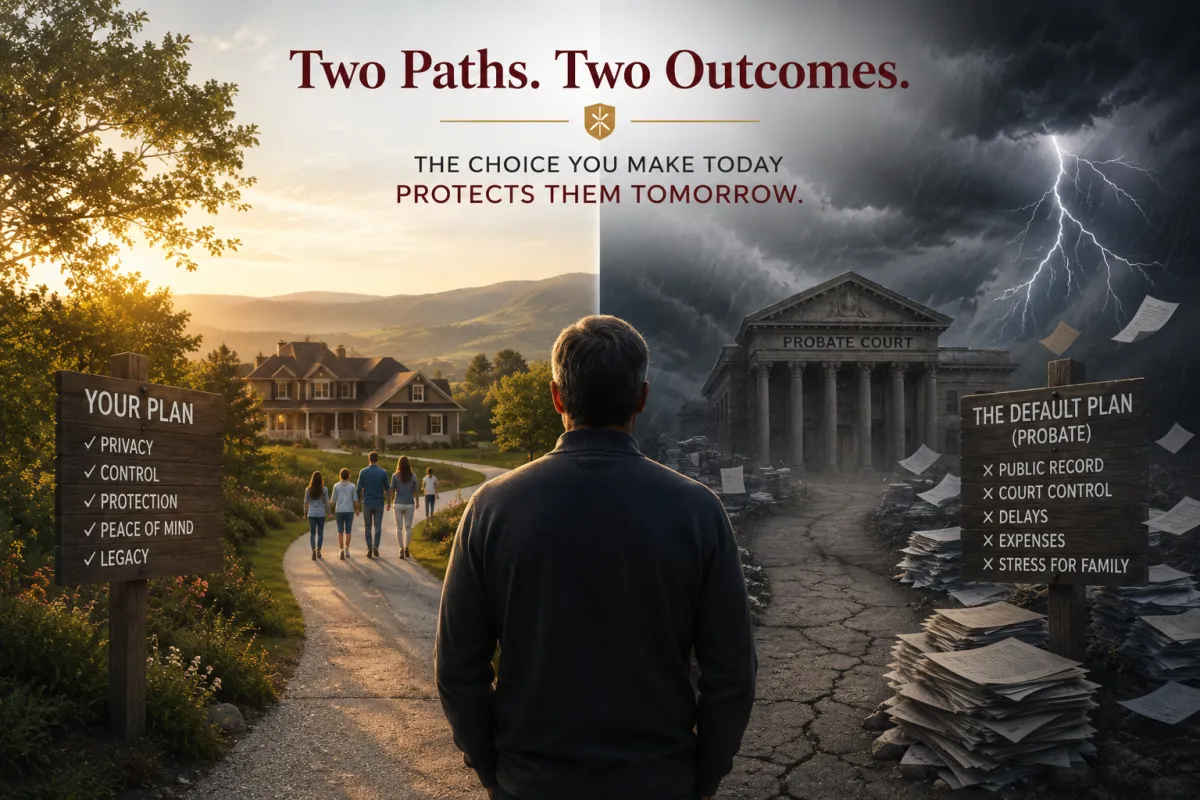
Here’s something most people don’t realize: there is no such thing as “not having a plan.” If you don’t create your own estate plan, the government already has one waiting for you. It’s called probate, and it’s the default.
So really, there are only two options:
The government’s plan (probate): the default if you do nothing
Your intentional plan (a trust): the one you choose for your family
A will, by itself, doesn’t get you off the government’s plan. It actually puts you squarely on it. When you die with a will, your estate still goes through probate. The will is just the document the court uses to carry out the process.
That surprises a lot of people. It surprised me too, the first time I really understood it.
What’s Coming Next
In the next article, I’m going to pull back the curtain on probate. What it actually is, what it costs in Oregon, how long it takes, and why it matters that it’s a matter of public record.
If you’ve ever heard someone say “probate” and nodded along without really knowing what it meant, that article is for you. And honestly, based on the rooms I’ve sat in, it’s for almost everyone.
Because once you understand probate, the question stops being “Do I need a will?” and starts being “How do I make sure my family never has to go through that?”
That’s a much better question. And it leads to a much better answer.
Stay tuned.
You're in the Driver's Seat
Where would you like to go from here?
To your success,

Christopher D. Moore
Estate Planning Educator
Fortis Planning, LLC
Email: [email protected]
Phone: (503) 308-7767

Article List
Article 1: Before You Die, You Need a…
Article 2: So You Have a Will. Here’s What That Actually Means.
Article 6: Is Your Family Protected? Here’s How to Find Out.