
Estate Planning Made Simple. Protection Made Certain.
ESTATE PLANNING ESSENTIALS | ARTICLE 4 OF 6

What Happens If You Can’t Speak for Yourself?
Most people think about estate planning as something that kicks in when they die.
But here is a question worth sitting with: what happens to you and your family if you are still alive but suddenly unable to make decisions?
A car accident. A stroke. A serious surgery with complications. A diagnosis that progresses faster than expected. These are not remote possibilities. They happen to real families, and when they do, the people who love you most are left in an impossible position without the right documents in place.
I know this firsthand. This year I had to step in and manage my father’s medical and financial affairs as his health declined. Watching someone you love in that situation is hard enough on its own. Navigating it without the proper legal framework in place makes it significantly harder on everyone involved.
That experience is why I consider incapacity planning just as important as the trust itself. In some ways, it is more urgent, because incapacity can happen at any age, and it can happen without any warning.
The Gap Most Plans Leave Open
When I ask people at seminars whether they have thought about incapacity planning, I usually get one of two responses. Either a blank look, or: "Well, I have a will."
A will does not help you here. A will only goes into effect when you die. If you are incapacitated but still alive, a will has no legal authority over anything.
Without the right incapacity documents, here is what can actually happen:
Your bank accounts may be frozen, even to your spouse
Medical providers may refuse to share information with your family due to HIPAA regulations
Your family may have to go to court to get a guardian or conservator appointed just to pay your bills or make medical decisions
That court process can take weeks or months and cost thousands of dollars
And the court, not your family, may decide who is in charge
This is the gap that incapacity planning closes. It is not complicated. But it has to be done in advance, before you need it. Once you are incapacitated, it is too late to sign these documents.
| You cannot plan in a crisis. The time to get this right is right now, while it is still entirely in your hands.
The Four Documents That Protect You
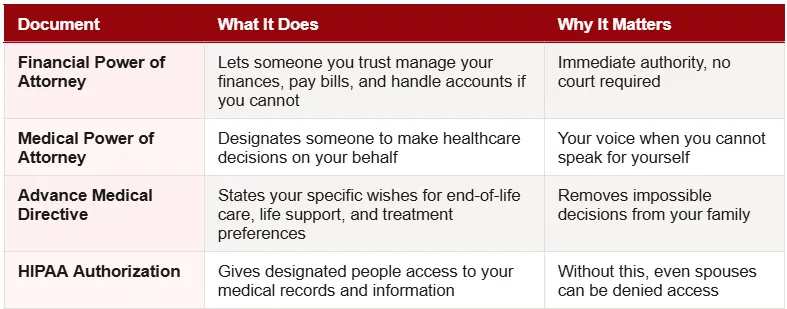
A complete incapacity plan has four components. Each one does something specific, and each one matters.
Financial Power of Attorney: Keeping the Lights On
A financial power of attorney designates someone you trust to manage your money if you cannot. That means paying your mortgage, handling your bank accounts, managing investments, filing taxes, and taking care of the financial details of daily life.
Without this document, your spouse or children may have no legal authority to access your accounts, even if your name is on them jointly in some cases. Banks and financial institutions take this seriously, and they should. But the result is that a family in crisis gets roadblocked at exactly the wrong moment.
Your agent under a financial power of attorney does not have unlimited power. You define the scope. You choose who it is. And it only activates when it is needed.
Medical Power of Attorney: Your Voice When You Cannot Speak
A medical power of attorney gives someone the legal authority to make healthcare decisions on your behalf if you are unable to make them yourself. This is different from an advance directive, which we will cover in a moment.
Your medical agent can speak with your doctors, review your records, consent to or refuse treatments, and advocate for you in the way you would advocate for yourself if you could. This is an enormous responsibility, and it should go to someone who knows you well and will honor your values, not just the person who happens to be nearby.
Choosing this person carefully matters. Have the conversation with them in advance. Make sure they understand what you would want.
Advance Medical Directive: Taking the Hardest Decisions Off Your Family
An advance medical directive (sometimes called a living will) is where you put your specific wishes about end-of-life care in writing. If you were on life support with no reasonable chance of recovery, what would you want? If you could no longer recognize your family or communicate, how long would you want extraordinary measures continued?
These are not easy questions. But they are far easier to answer now than they are to answer in a hospital waiting room at 2 in the morning.
I have seen what happens when families are left to make these decisions without any guidance from the person they are making them about. It creates conflict, guilt, and grief that can last for years. An advance directive removes that burden. It is one of the most loving things you can do for the people who care about you.
| An advance directive is not about giving up. It is about making sure the people you love never have to make an impossible decision alone.

HIPAA Authorization: The One People Always Forget
The Health Insurance Portability and Accountability Act (HIPAA) protects your medical information. That is generally a good thing. But it also means that without a signed authorization, your doctors may not be able to share details about your condition with anyone, including your spouse or adult children.
I have heard from families where a husband was hospitalized, and his wife was told she could not get information about his condition because no authorization was on file. That is not a hypothetical. It happens regularly.
A HIPAA authorization is typically a simple one or two page document. It designates who can access your medical information. It costs almost nothing to add to your estate plan, and it can matter enormously in a crisis.
How This Fits With Your Trust
If you read Article 3, you know that a revocable living trust handles the distribution of your assets when you die. But a trust, on its own, does not automatically address incapacity for assets held outside the trust or for medical decisions.
A complete estate plan brings all of these pieces together:
Your trust handles asset distribution at death and can address incapacity for trust assets
Your financial power of attorney covers assets and accounts that may not be in the trust
Your medical power of attorney and advance directive cover healthcare decisions
Your HIPAA authorization ensures your designated people can actually get information
Each document has a specific job. Together, they make sure that no matter what happens, the people you trust are empowered to act, and the people you want to protect are protected.
One Last Thing Worth Saying
A lot of people put this off because thinking about incapacity or death is uncomfortable. I understand that. But I want to reframe it slightly.
Getting these documents in place is not an act of fear. It is an act of love. It is saying to your spouse, your kids, your family: I thought about this so you would not have to. I made the decisions so you would not be left guessing. I set this up so that if something happens, you can focus on each other instead of fighting a legal system.
That is what planning actually is. It is taking care of the people who matter most to you, even when you are not there to do it in person.
One more article to go. In Article 5, we are going to bring everything together and talk about what getting started actually looks like, and why the cost of doing nothing is almost always higher than people realize.
Almost there.
Incapacity planning is one of those things that feels easy to put off until it is not. If you want to make sure the right people can step in for you without a fight, let’s have a conversation. At Fortis Planning, we offer a free 60-minute educational consultation. No pressure, no obligation. Just clarity. Reach out at [email protected] or visit fortisplanning.com.
You're in the Driver's Seat
Where would you like to go from here?
To your success,

Christopher D. Moore
Estate Planning Educator
Fortis Planning, LLC
Email: [email protected]
Phone: (503) 308-7767

Article List
Article 1: Before You Die, You Need a…
Article 2: So You Have a Will. Here’s What That Actually Means.
Article 6: Is Your Family Protected? Here’s How to Find Out.