
Estate Planning Made Simple. Protection Made Certain.
ESTATE PLANNING ESSENTIALS | ARTICLE 5 OF 6

You Have a Trust. But Is It Actually Working?
People ask me all the time: "Are you an estate planning attorney?"
And I always say no. Then I tell them they should be glad I am not.
Here is what I mean by that.
There are outstanding estate planning attorneys in Oregon. Talented, experienced professionals who can draft a trust that is legally airtight. I work alongside them, I refer clients to them, and I have a great deal of respect for what they do.
But here is the thing about attorneys: their job is to draft your documents. Once those documents are signed, their engagement is typically complete. They move on to the next client. Nobody calls you in six months to ask if you bought a new house. Nobody checks in when you refinance, open a new account, start a business, or inherit assets from a parent. Nobody makes sure the plan you paid for is still working the way it was designed to work.
That is the gap. And it is a much bigger gap than most people realize.
The Number That Should Concern Every Trust Owner
Based on what we see when we review trusts for new clients, the numbers are sobering.


Read that again. One in four trusts we review offers zero protection whatsoever. The family paid thousands of dollars for a document that will not do a single thing for them when they need it most.
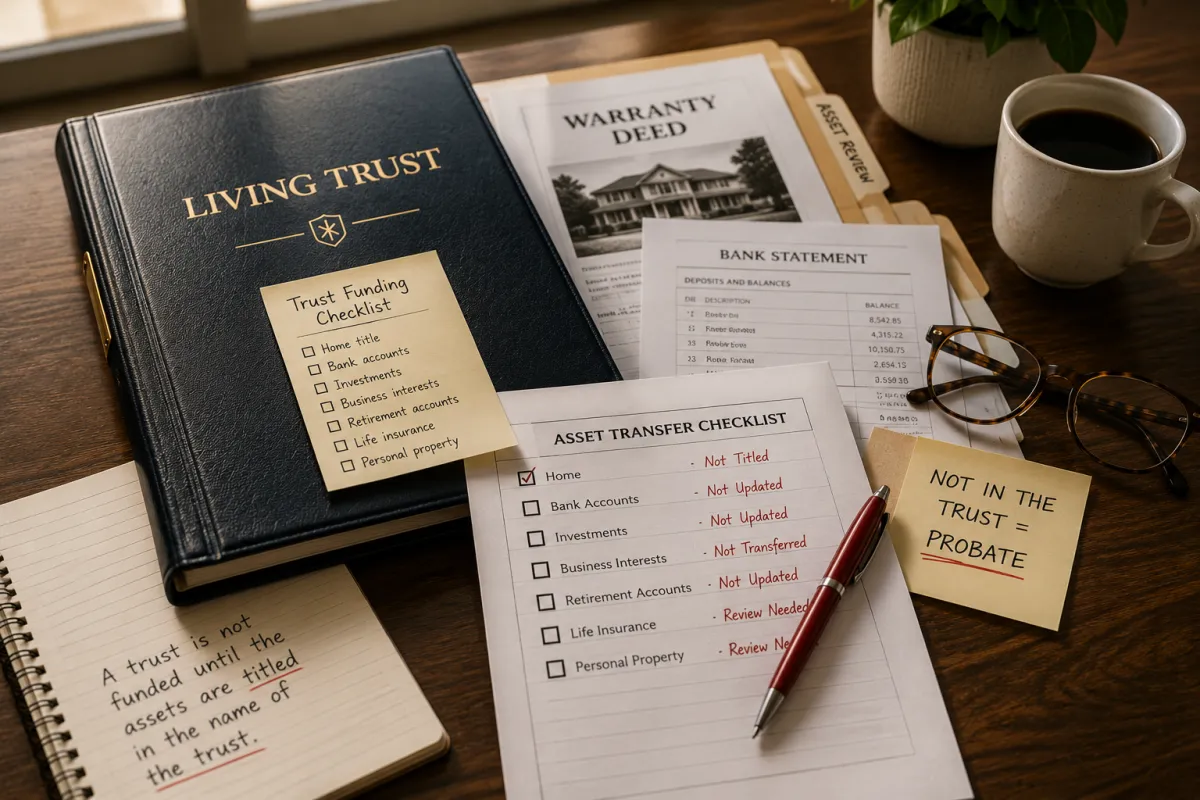
| A trust that is not funded is not a plan. It is an expensive stack of papers.
This is not a criticism of the families who have these trusts. Most of them had no idea. Nobody told them. Nobody followed up. And nobody ever sat down with them and walked through what "funding" actually means and why it matters so much.
What Funding Actually Means
Funding a trust means transferring ownership of your assets into the trust. The trust has to actually hold the things it is supposed to protect.
That means your home needs to be re-titled in the name of the trust. Your financial accounts need to be updated. Your investment accounts, your business interests, your rental properties. Anything with a title, a deed, or an account number needs to be reviewed and, where appropriate, transferred.
It sounds straightforward. In practice, it requires coordination with your county recorder, your financial institutions, your insurance providers, and sometimes your CPA. It is not complicated, but it does take time and follow-through. And it is exactly the kind of work that falls through the cracks when nobody is assigned to it.
Two Stories That Made This Personal
I want to share two situations that illustrate how common this problem is. Both are real. Names and identifying details have been changed.
My own mother.
My mom and stepfather have had a trust in place for years. They are the prepared side of my family. They did everything right. Four years ago they sold their home in Portland and purchased a new home in Redmond, Oregon. In the process of buying the new home, the property was never re-titled in the name of the trust.
My mother is 76. My stepfather is 83. Had something happened before we caught it, that home would have gone straight to probate. One life event, one overlooked step at closing, and years of careful planning would have been undermined at exactly the moment it mattered most.
This is not unusual. It is actually one of the most common ways trusts break down. Real estate transactions are busy, the title company is focused on closing the deal, and unless someone is specifically watching for trust titling, it gets missed.
A retired pastor named Robert.
Robert spent 34 years in ministry. A company came through his church offering estate planning services and set him and his wife up with a living trust. He later asked me to take a look at it as a friend.
When I reviewed the documents and compared them against his actual assets, neither of his two homes were in the trust. His financial accounts were not in the trust. The trust existed. The funding did not.
Robert had no idea. He had done what he thought was the responsible thing, paid for a professional plan, and trusted that the work was complete. Nobody had ever told him that creating the trust was only the first step.
We fixed it. But it required going back and doing the asset transfer work that should have been done when the trust was first set up. For two years, his family had been completely unprotected without knowing it.
What We Do Differently
At Fortis Planning, funding the trust is not a checkbox. It is a core part of what we deliver, and it is ongoing.
When we help a client create an estate plan, we coordinate the full implementation process. That means working with you to identify every asset that belongs in the trust, guiding you through the transfer process for each one, and making sure the paperwork is done correctly. We work alongside your attorney, your financial institutions, and your title company so nothing falls through the cracks.
And then we stay involved.
Every year, we reach out for a review. Has anything changed? Did you buy or sell property? Open new accounts? Receive an inheritance? Start a business? Get married or divorced? Any of those events can affect your trust, and we want to make sure your plan reflects your current life, not the life you had when you signed the documents.
Attorneys are not going to call you every year. That is not their model. It is ours.
| Creating the trust is the beginning of the plan. Funding it and maintaining it is the plan actually working.

If You Already Have a Trust
If you have a trust and you are reading this, I want to ask you a direct question: when did you last have it reviewed?
If the answer is "never" or "I am not sure," that is worth paying attention to. If you have bought or sold property, changed financial institutions, opened new accounts, or experienced any significant life change since your trust was created, there is a real chance something needs to be updated.
A trust review with us is not a sales call. We will sit down with your documents, walk through your assets, identify any gaps, and give you an honest picture of where things stand. If everything is in order, we will tell you that. If something needs attention, we will show you exactly what it is and what to do about it.
You spent money on that trust. You deserve to know if it is actually protecting your family.
If You Do Not Have a Trust Yet
Everything we have covered in this series points in the same direction. A properly structured and fully funded living trust is the most effective tool most Oregon families have for protecting what they have built and making things as easy as possible for the people they love.
The question is not just whether you have one. It is whether it is working.
That is what we make sure of. Every time.
One more article to go. In the final piece of this series, we bring everything together and talk about what taking the next step actually looks like, and why the cost of doing nothing is almost always higher than people expect.
Stay with me.
If you already have a trust and have not had it reviewed recently, that review is exactly where we start. If you are thinking about getting a plan in place, we can walk you through the whole picture. Either way, the conversation is free, there is no obligation, and you will leave knowing exactly where you stand. Reach out at [email protected] or call (503) 308-7767.
You're in the Driver's Seat
Where would you like to go from here?
To your success,

Christopher D. Moore
Estate Planning Educator
Fortis Planning, LLC
Email: [email protected]
Phone: (503) 308-7767

Article List
Article 1: Before You Die, You Need a…
Article 2: So You Have a Will. Here’s What That Actually Means.
Article 6: Is Your Family Protected? Here’s How to Find Out.