
Estate Planning Made Simple. Protection Made Certain.
ESTATE PLANNING ESSENTIALS | ARTICLE 3 OF 6

Wouldn’t It Be Nice If There Were a Better Way?
Over the past two articles, we have covered a lot of ground.
You learned that a will does not do what most people think it does. You learned that whether you have a will or not, your estate still goes through probate when you die. You learned what probate actually costs in Oregon: 3% to 8% of your estate, 6 to 18 months of waiting, and every detail of your financial life becoming a matter of public record.
So now I want to answer the question I always ask at this point in my seminars:
| Wouldn’t it be nice if there were a way to avoid all of that?
There is. It is called a revocable living trust. And for most families, it is the single most important planning decision they will ever make.
What a Living Trust Actually Is
A living trust is a legal document you create while you are alive (that is the "living" part) that holds your assets and spells out exactly what happens to them when you die or if you become incapacitated. It is revocable, which means you can change it, update it, or dissolve it any time you want while you are alive.
Here is the key distinction: unlike a will, a trust does not go through probate. When you pass away, your successor trustee (the person you designate to step in) can immediately begin distributing your assets according to your instructions. No court. No waiting. No public record. No 3% to 8% off the top.
Your family gets what you intended them to have, the way you intended them to have it, on a timeline that actually respects their situation.
What a Trust Does That a Will Cannot
Let me walk you through the benefits the way I walk families through them in person, because this is where it starts to click for people.
It avoids probate completely.
This is the headline. A properly funded trust passes your assets directly to your heirs without any court involvement. What took 6 to 18 months under probate can happen in a matter of weeks.
It protects you if you become incapacitated.
This one matters more than people realize, and it is personal for me. When I had to step in and manage my father’s medical and financial affairs this year, the experience of navigating that without the right documents in place was something I would not wish on any family. A living trust, combined with a financial power of attorney and medical directives, means the people you trust can act on your behalf immediately. No courts, no delays, no guesswork.
It keeps your information private.
Everything in a trust stays between you and your family. No public filing. No court record. No strangers, creditors, or estranged relatives combing through what you owned and who you left it to.
It transfers your assets immediately.
Your family does not have to wait for a court to release frozen accounts. If your spouse needs access to funds the week after you pass, they have it. If your kids need the house settled quickly, it can happen. The trust moves at your family’s pace, not the court’s.
It protects your heirs.
A trust can be written to protect what you leave behind from your heirs’ creditors, divorces, or financial missteps. You can structure distributions so a young adult does not receive a lump sum at 18. You can build in protections for a child with special needs. You have control that a will simply cannot give you.
It often reduces taxes.
Depending on the size of your estate and how the trust is structured, there can be meaningful tax advantages. This is one of the reasons we always recommend working with a coordinated team including your CPA.
Side by Side: The Two Plans
I want to make this as concrete as possible, because the numbers tell the story better than anything else.
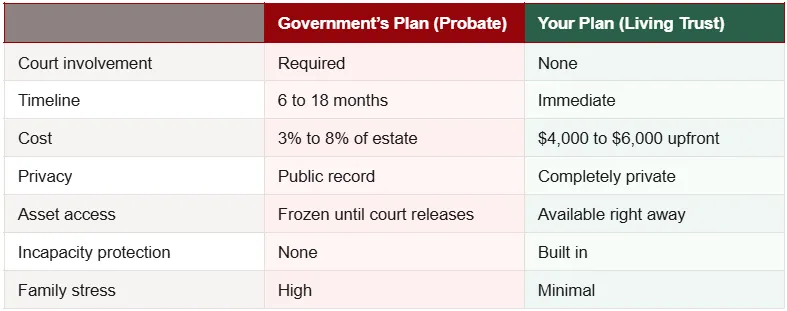
There is really no comparison. A trust costs more upfront, but it costs your family far less in the end, and not just financially.

The Myth That Trusts Are Only for the Wealthy
I hear this constantly, and I want to address it directly: trusts are not just for rich people.
If you own a home in Oregon, you have an estate. The average home value in Oregon is around $540,000. Running that through probate at 3% to 8% costs your family $15,000 to $43,000. A properly structured trust costs $4,000 to $6,000. The math is not close.
A trust is not a luxury. For most Oregon families, it is the most financially responsible decision they can make.
One Critical Detail: Funding the Trust
Here is something that does not get talked about enough, and it is important enough that I want to flag it now even though we will cover it more fully in a later article.
A trust that is not funded is useless.
Funding means actually transferring your assets into the trust. Your home needs to be re-titled. Your financial accounts need to be updated. Your trust needs to actually own the things it is supposed to protect. If you create a trust and never fund it, your estate still goes through probate as if the trust never existed.
This is one of the most common mistakes we see, and it is entirely preventable. It is also one of the reasons that at Fortis Planning, we do not just help you create your documents. We make sure your trust is properly funded and we check in annually to make sure it stays that way.
What’s Coming in Article 4
Next, I want to talk about something that does not get enough attention in estate planning conversations: what happens if you are still alive but unable to make decisions for yourself.
Incapacity planning is not a morbid topic. It is one of the most practical and loving things you can do for your family. And based on my own experience stepping in for my father this year, it is something I feel very strongly about.
If you have ever wondered what a power of attorney actually does, or what would happen to your finances and your medical care if you were suddenly unable to speak for yourself, that article is for you.
See you there.
If you are ready to stop wondering and start knowing where your family stands, let’s talk. At Fortis Planning, we offer a free 60-minute educational consultation. No pressure, no obligation. Just an honest conversation about what makes sense for your situation. Reach out at [email protected] or visit fortisplanning.com.
You're in the Driver's Seat
Where would you like to go from here?
To your success,

Christopher D. Moore
Estate Planning Educator
Fortis Planning, LLC
Email: [email protected]
Phone: (503) 308-7767

Article List
Article 1: Before You Die, You Need a…
Article 2: So You Have a Will. Here’s What That Actually Means.
Article 6: Is Your Family Protected? Here’s How to Find Out.