
Estate Planning Made Simple. Protection Made Certain.
ESTATE PLANNING ESSENTIALS | ARTICLE 2 OF 6

So You Have a Will. Here’s What That Actually Means.
In my last article, I asked you to finish this sentence: "Before I die, I need to have a _____."
Almost everyone said a will. And when I asked why, the answer almost always came back to the same thing: it’s what they were told. It’s what their parents had. It felt like the responsible thing to do.
So today I want to answer the question I ask next in every seminar I run:
| Do you know what actually happens when you die with a will?
Because most people don’t. And once you understand it, everything changes.
Let’s Talk About Probate
When you die with a will, your estate goes through a legal process called probate. A lot of people have heard that word. Very few know what it means in practice.
Here is the short version: probate is the court-supervised process of validating your will, paying your debts, and distributing what’s left to your heirs. The court is in charge. Your family is not. And until that process is complete, your assets are frozen.
Nobody can sell the house. Nobody can access the accounts. Nobody can do much of anything except wait.
Now here is the part that surprises people most. Dying without a will? That also goes through probate. The court just uses Oregon’s default rules instead of your document to decide who gets what.
Either way, your family ends up in the same place: a courthouse, waiting.
What Probate Actually Costs in Oregon

I want to give you real numbers, because vague warnings don’t change behavior. Specific ones do.
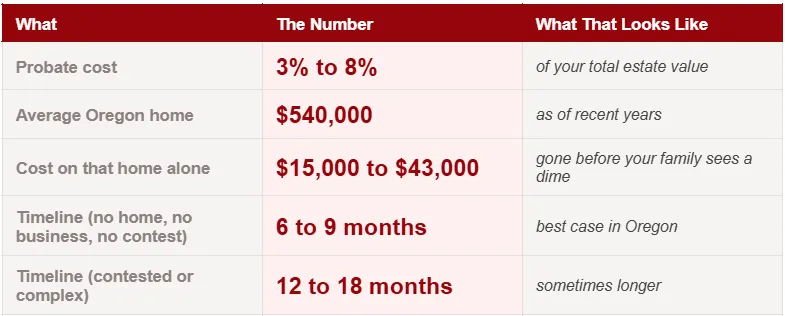
Read those numbers again. Then ask yourself: is that the plan you want for your family?
And by the way, those cost percentages apply to the gross value of your estate, not just what’s left after your mortgage or debts. So if your home is worth $540,000 and you still owe $300,000 on it, probate costs are still calculated on the $540,000.
The Part Nobody Warns You About: Public Record

There is something beyond the cost and the timeline that I want to make sure you understand, because it is the piece most people have never even considered.
When your estate goes through probate, everything becomes public record.
Your assets. Your debts. Who you owed money to. What you left. Who got it and who didn’t. All of it is filed with the court and available for anyone to see.
I have sat with families who were blindsided by this. A grieving widow dealing with creditors showing up. Adult children finding out for the first time that a sibling was left out. Estranged relatives using public court records to contest the estate and delay distribution for months.
None of that happens by accident. It happens because the information is available, and people use it.
| Privacy is not just a luxury in estate planning. It is protection.
The Stress Nobody Talks About
Beyond the dollars and the timeline, there is something harder to quantify but just as real: what probate does to families.
Your family is already grieving. Now they are also navigating a legal process they have never dealt with before, waiting on a court that moves on its own schedule, unable to access money they may need right now for funeral costs, mortgage payments, or daily living expenses.
I have seen probate turn close families into adversaries. Not because anyone was greedy. Because the process creates pressure, and pressure finds every existing crack.
That is not the legacy most parents want to leave their kids.
So Why Does Everyone Still Talk About Wills?
Honestly? Because wills are familiar. They have been around forever. People saw their parents get one, so they assumed that was the right move.
A will does serve a purpose. It can name guardians for minor children. It can express final wishes. In some situations, it is part of a complete estate plan. But on its own, a will does not protect your family from probate. It is the document the court uses to run the process, not a way around it.
Understanding that difference is not a small thing. It is the whole thing.
There Is Another Way
In the next article, I am going to show you what a properly structured living trust actually does, and why it is the tool that lets your family skip all of this entirely. No court. No waiting. No public record. No 3% to 8% haircut off the top.
You have already done the hard part by reading this far. Most people never get this far. They assume a will is enough and move on.
Stay with me. The next one is where it starts to feel like real relief.
Talk soon.
If reading this made you wonder whether your family is protected, that’s worth a conversation. At Fortis Planning, we offer a free 60-minute educational consultation. No pressure, no obligation. Just clarity about where you stand and what your options are. Reach out at [email protected] or visit fortisplanning.com.
You're in the Driver's Seat
Where would you like to go from here?
To your success,

Christopher D. Moore
Estate Planning Educator
Fortis Planning, LLC
Email: [email protected]
Phone: (503) 308-7767

Article List
Article 1: Before You Die, You Need a…
Article 2: So You Have a Will. Here’s What That Actually Means.
Article 6: Is Your Family Protected? Here’s How to Find Out.